You Can’t Print More Beachfront, but You Can Own It in Aruba
Reading Time: 5 min
Today, wealth often feels intangible. In a world of stocks, digital assets, and market noise, the tangible allure of land offers a refreshing contrast. Especially appealing is land that is not only beautiful but also inherently scarce, such as the beachfront estates found in Aruba.
Regardless of whether you’re a seasoned investor or someone quietly looking for a place to protect what you’ve earned, Aruba offers a rational investment backed by scarcity, stability, and structure, because while markets fluctuate and currencies lose value, beachfront land can’t be printed or altered.
Real Estate as a Hedge Against Inflation
When inflation chips away at purchasing power, most people seek assets that will hold or ideally increase their value over time, like gold, bonds, or blue-chip stocks. Yet, there’s another historically proven hedge that cannot be beaten: real estate.
Real estate, unlike cash or short-term savings vehicles, is a tangible asset that tends to appreciate in value with inflation. In markets like Aruba, where land availability is naturally limited and demand is steadily growing, the hedge becomes even stronger.
Inflation increases the replacement cost of property (materials, labor, construction) and boosts the value of existing properties, especially in sought-after locations. Notice that Aruba’s economy has remained impressively stable. This is partly because global inflation trends have made hard assets like island real estate far more appealing to international buyers looking for consistency.
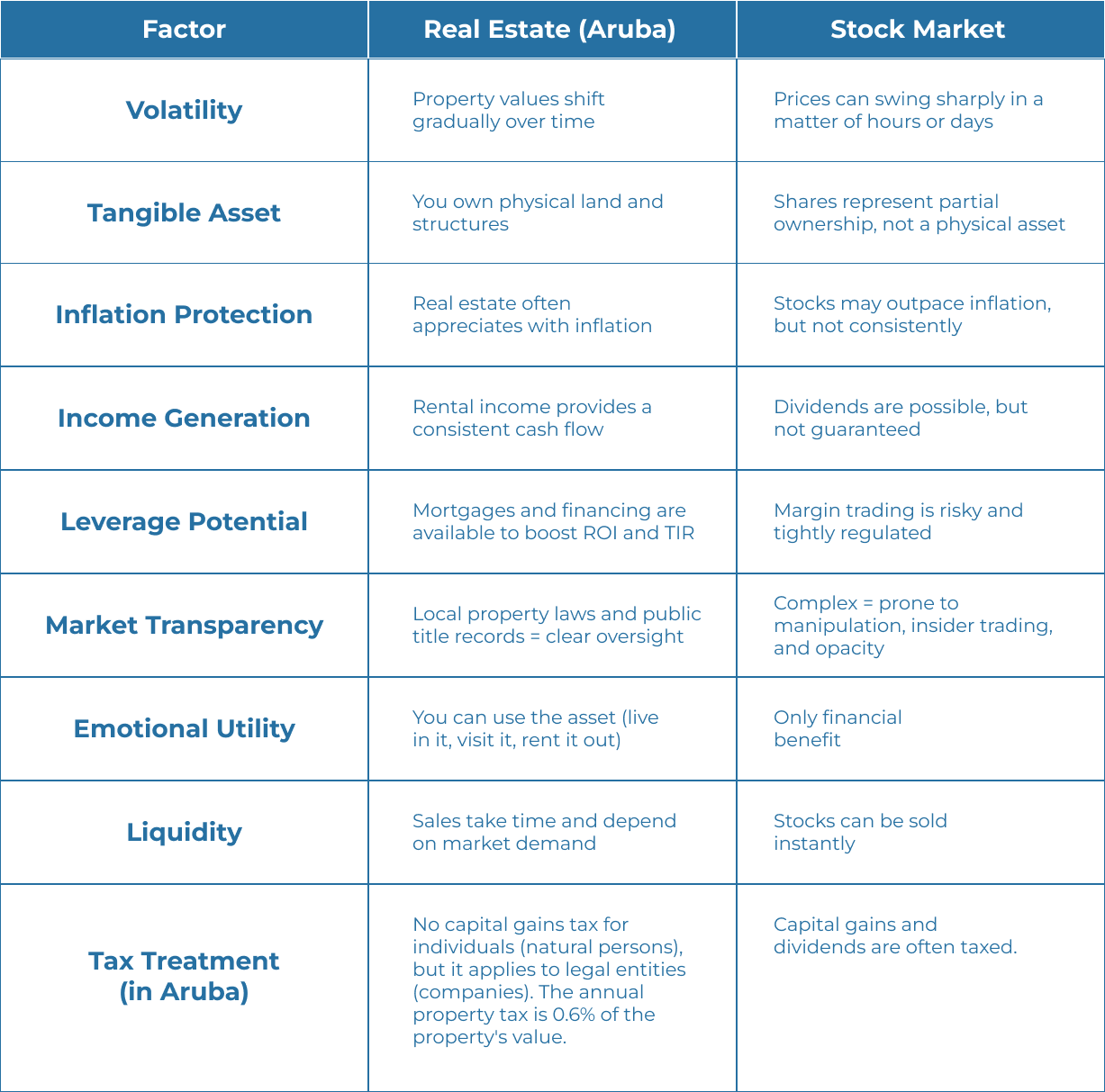
Comparing Real Estate vs. Stock Market Risks
The stock market has its moments of brilliance and, naturally, its breakdowns. Real estate, by contrast, offers something that equities rarely can: tangible use and lifestyle value, even when markets cool or crash.
In Aruba, where demand for luxury rentals and second homes remains strong, your investment can deliver lifestyle benefits, consistent rental income, and long-term capital growth.
Why Island Property Appreciates Differently
Unlike major cities that can sprawl endlessly outward, Aruba has a hard boundary: water. The island’s total land mass is fixed, and so is its development capacity. Add to that strict zoning laws, environmental protections, and controlled tourism growth, and you’ve got a textbook case of inherently limited supply, which is the foundation of long-term appreciation.
Island property also benefits from something intangible but powerful: emotional demand. The magic of coastal living — the dream of stepping out onto your balcony to a view of the Caribbean Sea — creates a premium that buyers are willing to pay. That emotional layer often shields island real estate from the sudden dips that affect more commoditized markets.
Moreover, Aruba’s appreciation is value-driven, not speculation-driven. Unlike markets that surge due to hype or foreign investor bubbles, Aruba’s growth is sustained by:
1.
Consistent buyer demand (U.S., Canadian, Dutch, and South American)
2.
Strong rental performance due to year-round tourism
3.
Infrastructure reliability that enhances livability and resale value
4.
Legal clarity and title security, powering long-term ownership
And because Aruba prioritizes quality over quantity, with a deliberate approach to development, the properties that exist today will likely become more valuable over time.
The Impact Of Scarcity and Demand
Aruba is roughly 70 square miles — smaller than most major U.S. cities — with strict development policies, flat terrain that limits sprawl, and high desirability. The result is simple economics in a location where limited supply meets consistent demand.
While other destinations may overbuild or face zoning confusion, Aruba enforces careful development planning. You won’t see skyscrapers clogging up the skyline here, and that’s exactly what helps preserve and grow your property’s long-term value.
Add to that:
A growing audience of remote workers and digital nomads
High airlift capacity via direct flights (JetBlue, United, Delta, KLM, etc.)
Tourism that grows incredibly quickly
In addition, you don’t just have demand, but sticky demand. Real estate in Aruba isn’t a hype cycle, it’s a long game.
Political and Economic Stability in Aruba
Investing abroad requires trust, not just in the property, but in the countrybehind it. Aruba offers a stable parliamentary democracy, functioning under the Kingdom of the Netherlands. Its legal system is based on Dutch civil law, and property rights are well-protected and clearly enforced. This serves as a significant advantage over other emerging-market islands.
Economically, Aruba has been praised by institutions like the Central Bank of Aruba and the IMF for its steady recovery and fiscal discipline. Tourism accounts for nearly 70% of the island’s GDP, yet the government has taken strong steps toward economic diversification, including by investing in renewable energy, fintech, and sustainable infrastructure.
The Aruban florin (AWG) is pegged to the U.S. dollar (1 USD = 1.79 AWG), removing foreign exchange risk for American investors. Furthermore, if inflation is making you mad, it is relatively controlled in Aruba, where the government’s monetary policies have been widely respected.
How Buying Land in Aruba Can Protect Your Wealth
In uncertain times, safe havens matter. And Aruba, with its legal stability, low corruption, and high investor protection, offers a dream-backed strategy.
By owning property in Aruba, you gain:
A hedge against inflation
A backup plan for personal mobility (second residency potential)
An asset that performs whether you use it, rent it, or pass it down
Protection from market volatility through physical, appreciating land
We know that flexibility means freedom. So, if you’re safeguarding your portfolio or giving your family the option to live a global lifestyle, owning land in Aruba puts you ahead of the curve, allowing you to stay in control.
Sources
Central Bank of Aruba – Economic Indicators & Market Overview View More
World Bank – Aruba Country Profile – Economic and Development Data View More
International Monetary Fund (IMF) – Aruba Staff Reports – Macroeconomic Stability & Policy Outlook View More
Global Property Guide – Aruba Real Estate Market – Rental Yield, Pricing, and Legal Overview View More
Forbes – Is Real Estate A Hedge Against Inflation? View More